Thermal Energy Storage: Part 3 — Energy Storage Beyond Electricity and Batteries
- Andreas Zemelka
Energy Isn’t Just Electricity – and Energy Storage Isn’t Just Battery Storage
Before discussing thermal energy storage (TES) in more detail, I would like to emphasize one important point: energy isn’t just electricity, and energy storage isn’t just battery storage.
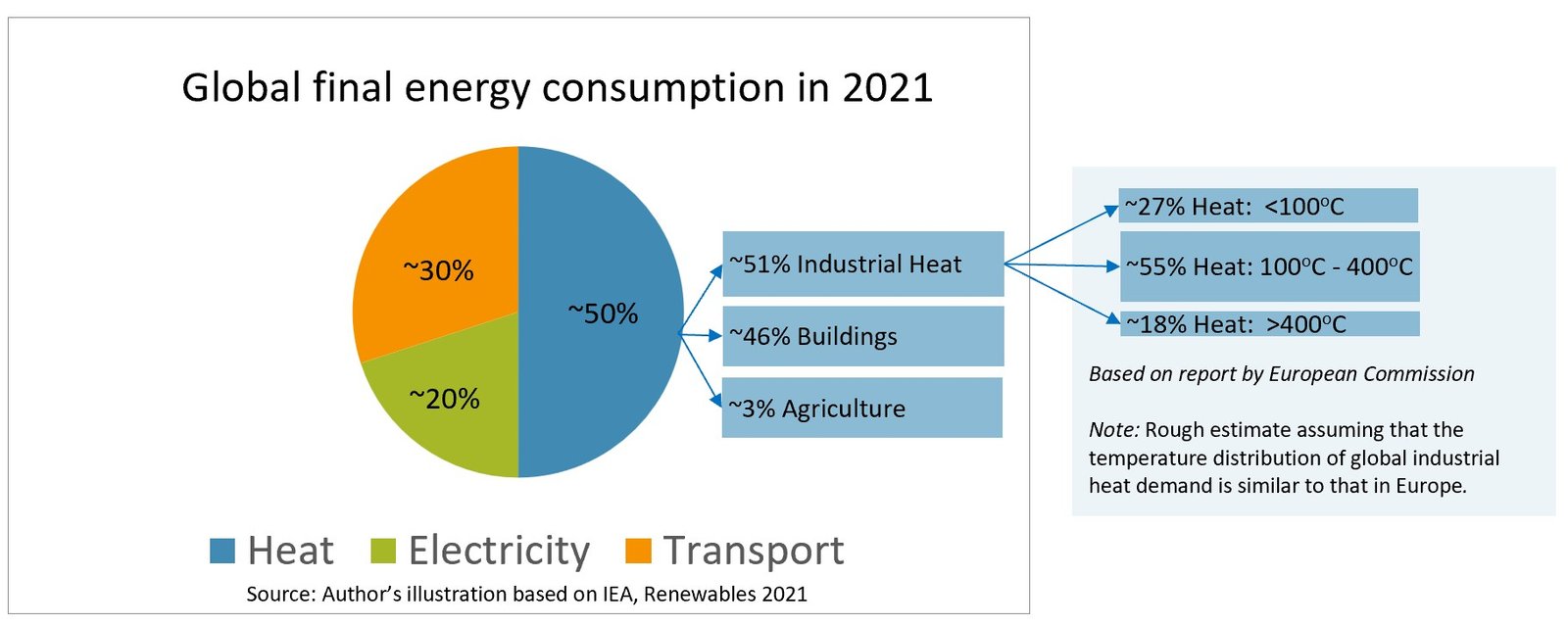
Even though the two sets of statistics—from the IEA and the European Commission—are not fully comparable, they illustrate the enormous scale of global heat demand and the challenge of replacing fossil-fuel-based heat generation with lower-carbon alternatives.
Every day we hear and read about decarbonization, the energy transition and the measures required to achieve it. The discussion is often influenced by different perspectives and interests, and proposed solutions are not always sufficiently considered in terms of technical feasibility, economic viability and practical implementation. As an engineer who has worked in the energy sector for decades, I believe that a successful energy transition requires well-considered policy decisions combined, above all, with technically sound and economically viable solutions. Thermal energy storage (TES) can be one of them.
Based on the figure above, and considering that heat demand in buildings is predominantly at relatively low temperatures, it can be estimated that almost 90% of global heat consumption requires temperatures below approximately 400°C. A substantial part of this demand is therefore within a temperature range that can potentially be addressed by various TES technologies.
Considering that a significant part of the low-temperature heat demand (<100°C) can be covered by relatively simple and cost-effective TES technologies, including systems using water as a storage medium, the medium-temperature range of approximately 100°C to 400°C still represents a considerable share of global heat demand. Based on the assumptions presented above, this corresponds to approximately 28% of global heat demand.
This is also the temperature range particularly relevant to the TES concept presented in the previous article, “Thermal Energy Storage – Part 2.” In absolute terms, the global energy demand involved is enormous. Even if only a small percentage of this heat demand were eventually supplied through thermal energy storage, it would represent both a major challenge and a significant opportunity for TES technology providers.
Some examples of typical temperature requirements for thermal applications that could potentially be supplied by TES include:
Heat in Buildings
- Space and water heating: generally <100°C
Industrial Heat
| Thermal seawater desalination: | <140°C |
| Drying processes: | <150°C |
| Pulp and paper industry: | <200°C |
| Food and beverage industry: approximately | 100–250°C |
| Textile industry: approximately | 100–250°C |
| Chemical industry: approximately | 100–250°C (with some processes requiring higher temperatures) |
| Preheating for industrial processes: approximately | 150–400°C or higher (depending on the process) |
| Preheating applications in thermal power plants: approximately | 150–400°C or higher (depending on the application) |
A practical starting point for TES deployment could be an existing heat network, such as an industrial steam network. In such a case, steam generated using energy stored in the TES could be supplied directly to the existing network.
The TES plant would not necessarily need to cover 100% of the heat demand from the outset or replace the entire existing heat-supply infrastructure. Initially, it could supply only a portion of the required thermal energy and subsequently be scaled up if the technical and economic expectations are fulfilled. Such an approach could allow businesses to introduce TES progressively while limiting the initial investment and associated project risks.
As already mentioned in the previous article, supplying heat is not the only potential function of TES. Equally important is its potential contribution to electricity-grid balancing. As a flexible electricity consumer, an electrically charged TES can adjust its charging pattern in response to electricity availability and grid conditions. Depending on the applicable electricity market and regulatory framework, this flexibility may also provide an additional source of revenue for the TES owner or operator.
More about this in the next article.