Pre-Owned Power Plants – An Alternative for Fast-Track Power Projects
- Andreas Zemelka
Content
- When Relocation Can Offer a Viable Alternative to Building New Structures
- Why Suitable Power Plants Become Available
- Key Advantage-1: Shorter Project Implementation
- Key Advantage-2: Lower Investment – and Potentially Earlier Revenues
- Proven Technology Can Be an Advantage
- Relocation Is Not Automatically the Cheaper Solution
- The Importance of the Right Project Approach
- Where Pre-Owned Plants Can Make Particular Sense
- Conclusion
- From Relocation Opportunity to Successful Project
1. When Relocation Can Offer a Viable Alternative to Building New Structures
Growing electricity demand, insufficient generation capacity and overloaded grids can create situations in which the conventional development of a new power plant simply takes too long. In other cases, available investment budgets may not support the development of an entirely new facility.
Such challenges are not limited to large utilities or independent power producers. They may equally affect industrial companies and other private consumers seeking to secure their own reliable and cost-effective power generation.
At the same time, opportunities exist on the other side of the market. Power plants may be decommissioned, mothballed or otherwise no longer required at their present location, even though they still have considerable technical value and remaining operating life. Instead of being permanently shut down and ultimately demolished, such plants may be available for acquisition and relocation.
This can create benefits for both sides of a transaction:
- The present owner (seller) may realise value from an asset that is no longer required.
- The future owner (buyer) may gain access to existing generation equipment that can potentially be implemented faster and at lower investment cost than an equivalent new-build solution.
Under such circumstances, the acquisition and relocation of an existing pre-owned power plant can provide a viable alternative worth considering.
A relocation project, however, should not be understood simply as purchasing used equipment, dismantling it and rebuilding it elsewhere. Properly developed, it is a complex techno-commercial project extending from the identification and assessment of a suitable asset through to engineering, dismantling, transportation, rehabilitation, reconstruction and commissioning at a new location.
The attractiveness of this approach is primarily based on two factors: Time and Cost
2. Why suitable power plants become available
A power plant offered for relocation is not necessarily at the end of its technical life.
Plants can become available for many reasons unrelated to their physical condition, including:
- Changes in fuel prices or electricity-market conditions
- Political or regulatory changes
- Changes in national fuel or energy strategies
- Expiry of a Power Purchase Agreement (PPA)
- Expiry of a Fuel Supply Agreement (FSA)
- Insolvency of a project company
- Cancellation or suspension of a project during construction
- Commercial decisions to replace an existing plant with a different generation technology
Consequently, plants offered for relocation can range from completely unused equipment to plants with relatively few operating hours or well-maintained facilities with substantial remaining technical life.
The term “pre-owned” therefore does not automatically mean “old” or “worn out.”
The important question is not simply the age of the plant, but its actual technical condition, operating history, maintainability, remaining lifetime and suitability for the intended new location.
3. Key Advantage-1: The main advantage: shortening the project schedule
Development of a conventional new power plant normally requires a sequence of activities including feasibility studies, specification, tendering, contracting, detailed engineering, manufacturing, construction and commissioning.
With a suitable existing plant, this sequence changes considerably.
Major equipment already exists. Its original design and operating characteristics are known and, in many cases, operating and maintenance records are available. Long procurement and manufacturing periods for major equipment can therefore largely be replaced by:
- Plant assessment and relocation planning
- Dismantling and preservation
- Transportation and logistics
- Re-engineering and site adaptation
- Rehabilitation and upgrading
- Reconstruction and commissioning
Indicative Comparison of Project Schedules
Conventional New-Build Power Plant vs. Relocation of a Pre-Owned Power Plant
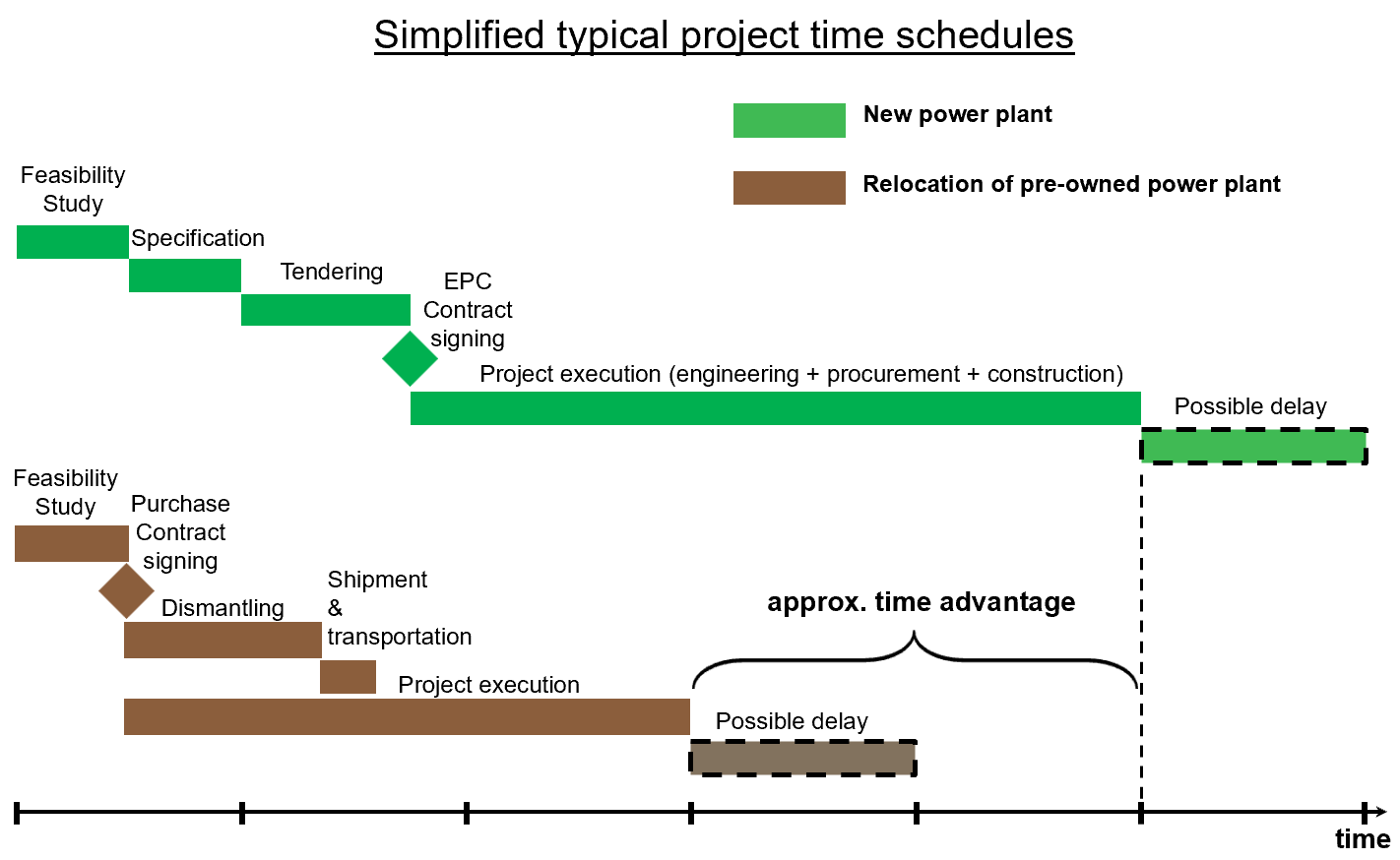
Depending on the project, relocation can result in a substantial reduction of the overall implementation period.
This schedule advantage can be particularly important where generation capacity is urgently required. Every month by which commercial operation can be advanced can have considerable economic value.
4. Key Advantage-2: Lower investment – and potentially earlier revenues
The relevant figure is the total installed and commissioned project cost at the new location.
In addition to the plant purchase price, this typically needs to consider:
- Technical inspection and condition assessment
- Dismantling, identification and preservation
- Packaging, transportation and logistics
- Engineering and adaptation to the new site
- Rehabilitation, overhaul and replacement of selected equipment
- Civil works and new foundations
- Balance-of-plant modifications
- Control and electrical system modifications
- Reconstruction and installation
- Testing and commissioning
Even after these costs are considered, a carefully selected plant may provide a substantial investment advantage compared with a new-build project.
There is also a second important economic effect:
Earlier operation can mean earlier revenue generation.
Illustrating the Potential Economic Benefits
The potential economic benefits can be illustrated by the simplified diagrams below. They show the typical relationship between project investment, implementation time, start of revenue generation and break-even point.
The diagrams illustrate the general principle and potential advantages and should not be regarded as a detailed economic analysis of a specific project.
New Power Plant
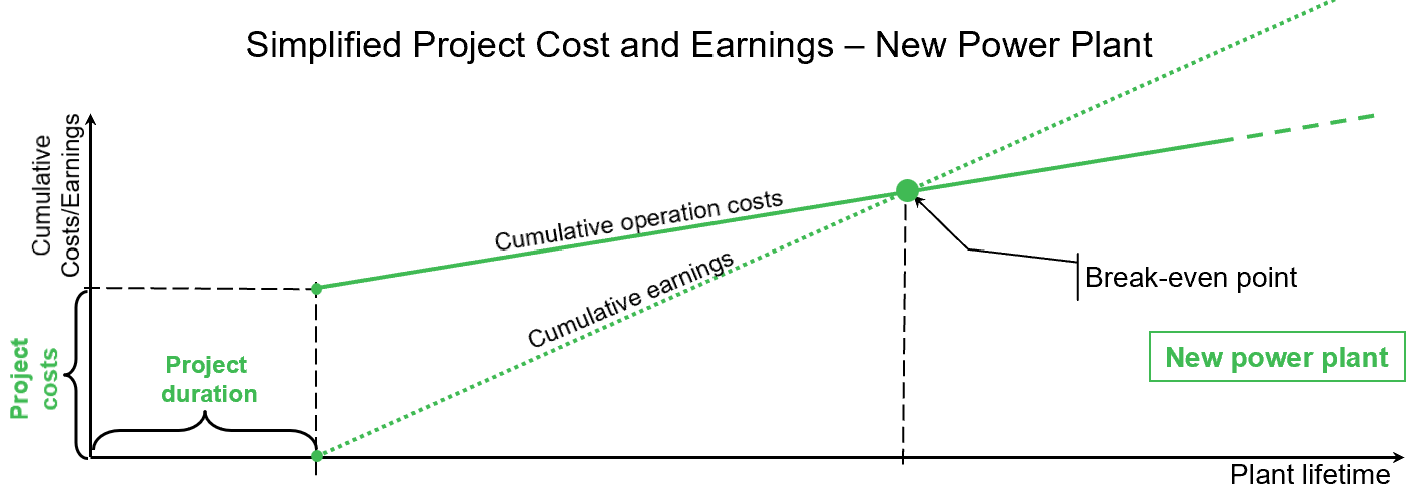
A conventional new-build project normally requires a longer development and construction period before the plant starts generating revenue. The capital invested therefore remains tied up for a comparatively long period before the project reaches its break-even point.
Relocated Pre-Owned Power Plant
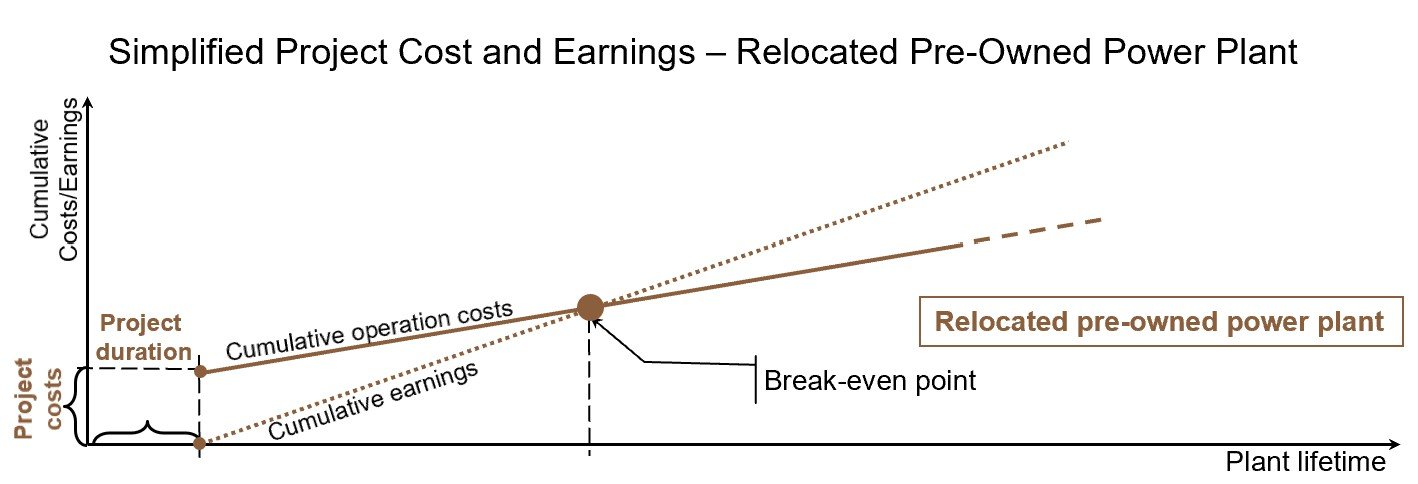
Figure 3 – Simplified Project Cost and Earnings – Relocated Pre-Owned Power Plant
A relocation project can normally be implemented within a shorter period and with a lower initial investment than a comparable new-build project. As a result, the plant can start generating revenue earlier and the project may reach its break-even point considerably sooner.
New vs. Relocated Pre-Owned Power Plant
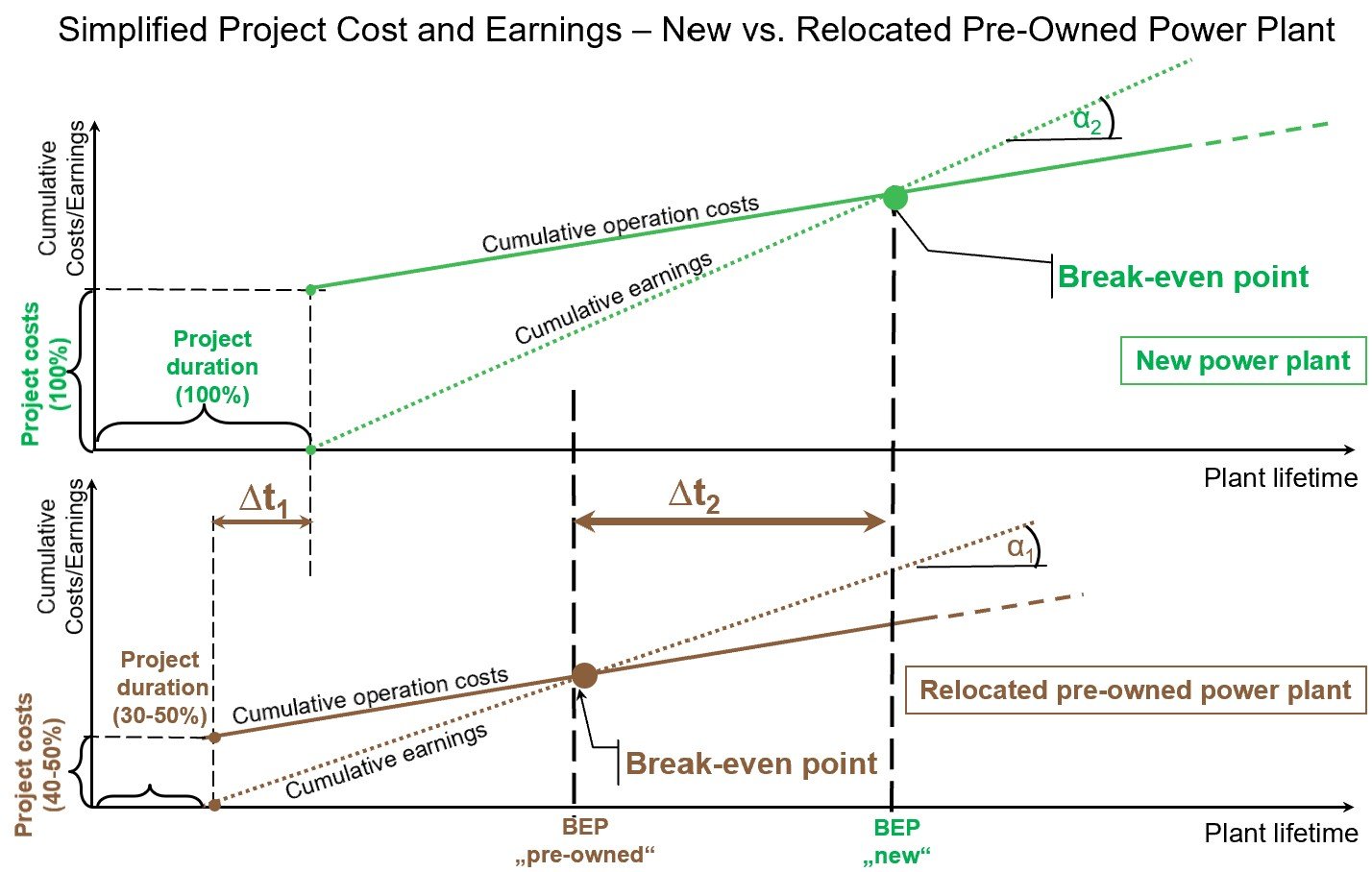
Figure 4 – Simplified Project Cost and Earnings – New vs. Relocated Pre-Owned Power Plant
The relocation concept can change the economic profile significantly through a combination of:
- Lower initial investment
- Shorter project implementation
- Earlier commercial operation
- Earlier revenue generation
- Potentially earlier break-even
The economic comparison should therefore consider not only CAPEX and remaining plant lifetime, but also the time required to reach commercial operation and the resulting break-even point.
5. Proven technology can be an advantage
- Proven design and performance based on actual operating experience
- Known operating characteristics rather than solely design assumptions
- Initial design, manufacturing or operational problems may already have been identified and corrected
- Operating and maintenance records may provide valuable information about equipment condition and recurring problems
- Experience of previous operating and maintenance personnel may support assessment, dismantling, reconstruction and recommissioning
- Original Equipment Manufacturers (OEMs) and specialised service companies can support inspections, remaining-life assessments, overhauls, upgrades and recommissioning
These factors can contribute to reducing some of the technical uncertainties normally associated with a new installation.
6. Relocation is not automatically the cheaper solution
The advantages should not obscure the risks.
A technically unsuitable plant purchased at an attractive price can ultimately become an expensive project. The most important decisions are therefore often made before the plant is purchased.
A professional assessment should consider, among others:
- Technical suitability – technology, fuel, operating regime and local conditions
- Condition and remaining lifetime – required overhaul, replacement and upgrading
- Expected performance – output, efficiency, availability and operating flexibility
- Site compatibility – ambient conditions, grid requirements, cooling concept, fuel supply and infrastructure
- Documentation – drawings, operating and maintenance records, software and technical documentation
- OEM and spare-parts support – long-term availability and maintainability
- Relocation cost and schedule – dismantling, transportation, rehabilitation, reconstruction and commissioning
- Commercial and contractual risks – equipment condition, performance, interfaces, responsibilities and warranties
Only after these issues have been adequately assessed can the real value of a pre-owned plant be determined.
7. The importance of the right project approach
Relocation projects differ fundamentally from conventional new-build projects.
A new plant is generally designed around the requirements of the new site. With a relocation project, the starting point is reversed:
An existing technical solution has to be adapted to a new environment.
This makes early technical due diligence, realistic cost and schedule assessment, and effective interface management particularly important.
The process should normally start with a high-level screening of available plants, followed by progressively more detailed technical and commercial assessment. Only plants satisfying the fundamental requirements of the intended project should proceed to detailed inspection, negotiations and acquisition.
The objective is not to find the cheapest available plant. It is to identify the plant offering the best overall techno-commercial fit for the intended project.
8. Where pre-owned plants can make particular sense
Relocation projects can be especially attractive where there is:
- An urgent requirement to bridge a generation shortfall or address power shortages and blackouts
- A need for additional capacity to stabilise or support an overloaded grid
- Demand for emergency, standby or temporary generation capacity
- Limited availability of project financing or a requirement to minimise initial capital investment
- A requirement for a short planning and implementation period
- A limited generation requirement, where the additional capacity may only be needed for a few years
- A time-limited Power Purchase Agreement (PPA) that may not justify investment in a new plant with a considerably longer economic life
- Uncertainty regarding future electricity demand, market conditions, fuel availability or future development of the power system
- A transitional requirement, for example until new generation capacity, grid infrastructure or another long-term solution becomes available
- A situation where the long design and economic life of a new power plant is neither required nor economically justified
In such cases, the shorter implementation time, lower capital requirement and potentially more appropriate remaining operating life of a suitable pre-owned plant may offer a better fit than a completely new installation.
9. Conclusion
Relocation of pre-owned power plants is not a universal solution to power-generation problems.
But neither should it be regarded simply as a second-best alternative to new equipment.
Under suitable circumstances, a carefully selected and professionally assessed existing plant can provide a technically sound and commercially attractive basis for a fast-track, lower-investment project.
While this article focuses primarily on power generation, the underlying concept is not limited to power plants. Similar opportunities may exist for process plants, refineries, chemical and petrochemical facilities, manufacturing plants and other industrial installations where existing assets can be economically dismantled, relocated, adapted and recommissioned at a new location.
The fundamental principles remain largely the same: identifying a suitable available asset, matching it with the requirements of a new project, assessing its condition and remaining life, evaluating the cost and feasibility of relocation, and developing an appropriate technical and commercial implementation concept.
The decisive factors are the quality of plant selection, the depth of the technical assessment, realistic evaluation of the total relocation cost and schedule, appropriate involvement of OEMs and specialised companies, and effective management of the many interfaces between the existing plant and its new environment.
Ultimately, the question should not be:
“New or used?”
It should be:
“Which solution provides the best combination of investment cost, implementation time, technical risk and required operating life for this particular project?”
10. From Relocation Opportunity to Successful Project
A relocation project starts long before dismantling begins. It often starts with two independent opportunities: a requirement for generation capacity on one side and a suitable plant that is no longer required at its present location on the other.
Bringing these opportunities together and developing them into a viable project requires a combination of technical, commercial and project-development expertise.
My particular focus is on the identification, assessment, development, facilitation and structuring of such opportunities, including:
- Identification of potential projects and buyers with a defined requirement for generation capacity
- Identification and screening of suitable pre-owned plants and potential sellers
- Matching available plants with the technical, commercial and operational requirements of potential projects
- Initial technical assessment and coordination of plant inspections and condition assessments
- Assessment of remaining lifetime, rehabilitation requirements, modifications and upgrades
- Development of preliminary relocation concepts, cost estimates and implementation schedules
- Techno-commercial evaluation and comparison with alternative solutions, including new-build options
- Facilitation and coordination between buyers, sellers and other key stakeholders
- Support in developing an appropriate commercial, contractual and project structure
- Support during negotiations, project development and subsequent execution
The subsequent relocation and implementation requires expertise across many disciplines, potentially including plant inspection, remaining-life assessment, OEM services, engineering, dismantling, logistics, rehabilitation and upgrading, civil works, construction, commissioning, legal and commercial expertise, and local knowledge at both the existing and future plant locations.
Through cooperation with experienced partners, specialised engineering companies, OEMs and other professional service providers, the necessary expertise can be brought together and tailored to the specific requirements of each project.
The objective is to take a relocation opportunity from an initial idea through plant identification, matching, technical and commercial assessment, project structuring and implementation and develop it into a technically sound, commercially viable and successfully executed project.
To be continued.